UGC vs Influencer Marketing: Cost per Asset in 2026

· 19 min read

Last updated: 2026-09-09
UGC creators win on cost per tested ad variant. Influencers win on reach you cannot buy any other way. A three-creator UGC package with edited videos, hook variations, and B-roll starts at $450 [3], while one Instagram post from a mega-influencer runs $15,000 to $50,000 or more as of March 2026 [2]. Pay the influencer when the job is putting the product in front of people who have never heard of it.
The table compares one deliverable from each side: the fee, who keeps the footage, and how fast it lands.
| Option | Best for | Typical fee per asset | Who owns the footage | Turnaround |
|---|---|---|---|---|
| UGC creator | Paid ad creative you re-cut and test | From $450 for a three-creator package with hook variants, B-roll, and CTAs [3] | Brand keeps the file; the license term is a separate clause | Five to seven days once the creator has the product [1] |
| Influencer | Awareness on an audience you do not own | $20–$500 per nano post on TikTok, $15,000–$50,000+ per mega post on Instagram (checked March 2026) [2] | Creator keeps the post; 51% charge a separate fee to whitelist or boost it [7] | Set by contract rounds, not by the shoot |
How we compared
How we compared
Four criteria decide every row on this page: rate per deliverable, what the usage rights actually grant, turnaround, and where the asset fits the funnel. Every figure comes from one of three tiers, and the tier is stated wherever it matters. Tier one is a vendor's own published pricing page, the only source that binds the vendor to a number — the $450 package rate is a vendor list price, not a market average [3]. Tier two is a platform or survey dataset large enough to produce bands rather than anecdotes: the per-post tiers, the whitelisting split, and the marketer performance figures all come from published surveys and platform data [2][7][4]. Tier three is a regulator's own guidance, which sets rules rather than prices [6]. A competitor's blog post appears only where it states that competitor's own position, labelled as framing rather than as a finding [5].
Every price is date-stamped to the month its source published it. Where a vendor keeps its number private, the cell reads "not published" rather than an estimate — which is why the perpetual-licence and whitelisting-add-on rows carry no figure at all rather than a plausible-looking one. Where the market has a working practice but no published number behind it, the sentence stays qualitative on purpose: turnaround uses the working standard of five to seven days once the creator has the product [1], and the kill-fee and reshoot norms in the checklist below are stated as common landing spots, not as rates. Sponsored influencer posts and paid UGC deliverables are scored as separate compliance categories, since any brand payment or free product has to be disclosed regardless of its dollar value [6].
Octohog
Reading about UGC is the slow way to get UGC.
Write the brief once. Octohog finds the creators who fit it, shows their real brand work, and runs the outreach that books them.
Start with a brief7-day free trial
UGC creators
A UGC creator is a paid content producer who shoots branded video for a company to run as its own ad creative, not for their own audience. The deliverable is typically a short-form vertical video of 15 to 60 seconds, cut for TikTok and Reels [1]. You buy the file. The audience you still have to pay for separately.
Followers do not gate this job. A creator with a locked account and no following can invoice a brand, because the brand is buying footage and a licence, not a post. Anyone quoting you a UGC rate off their follower count has priced the wrong product. Ask instead what arrives in the folder: how many hooks, how many revision rounds, whether raw files come with the edit, and whether it lands watermark-free.
The licence is the line that moves the price, not the camera. Organic-only use, paid ads, and perpetual whitelisting are three different products cut from the same shoot, and creator rights end wherever the term you wrote down ends. Put the term in months and name the channels before anyone sends a quote. Vague rights are how a $200 video becomes a $200 video you cannot run in December.
Content ownership is the entire reason this line item survives a content marketing budget review. Owned files feed paid ad creative testing, which needs eight versions of one claim and needs them cheap. An influencer post cannot be split into hooks and re-run against a new audience. A file can, all quarter, in whatever aspect ratio the placement wants.
Influencer marketing
Influencer marketing is paying someone with an existing audience to post about your product on their own account, so the fee buys distribution and trust transfer rather than a file you keep. The account is the media placement. When the post comes down, the campaign comes down with it.
Tiers price off follower count, and the bands behave differently enough that they are not really the same purchase:
- Nano (1,000 to 10,000 followers): $20 to $500 per sponsored TikTok post as of March 2026 [2]. Comment sections still read like conversations at this size.
- Nano on YouTube (1,000 to 10,000 subscribers): $100 to $500 per sponsored post as of March 2026 [2]. Longer shelf life than a Reel, slower to book.
- Micro: niche category audiences, the only tier most DTC brands can afford to re-book monthly instead of once a quarter.
- Macro: regional or category-wide reach, usually agency-managed, rate cards negotiated rather than published — which is why no macro figure appears anywhere on this page.
- Mega: priced like a media buy and booked through management at $15,000 to $50,000 or more per Instagram post [2], a number that only clears once a nano cohort has already proven the creative it will amplify.
- Disclosure, every tier: any payment or free product creates a material connection that must be stated where a viewer cannot miss it, not on an About page or behind a "more" button [6].
Macro is the band where the published evidence runs out, and that is the argument against it. Nano and mega both have surveyed rate bands attached [2]; macro has negotiated deals and no dataset, so the price you are quoted cannot be checked against anything. The audience question is unmeasured in the same way. Nobody publishes the overlap between a national account's followers and a given category's buyers, so social media marketing reports impressions because impressions are what arrived. Nano and micro are where the arithmetic still works, because a 10.3% average engagement rate on nano TikTok [9] is a number a macro placement can be held to. What would change the calculation: an audience-overlap report showing a macro account's followers already buy in your category.
UGC vs influencer marketing: the 2026 rate card by deliverable
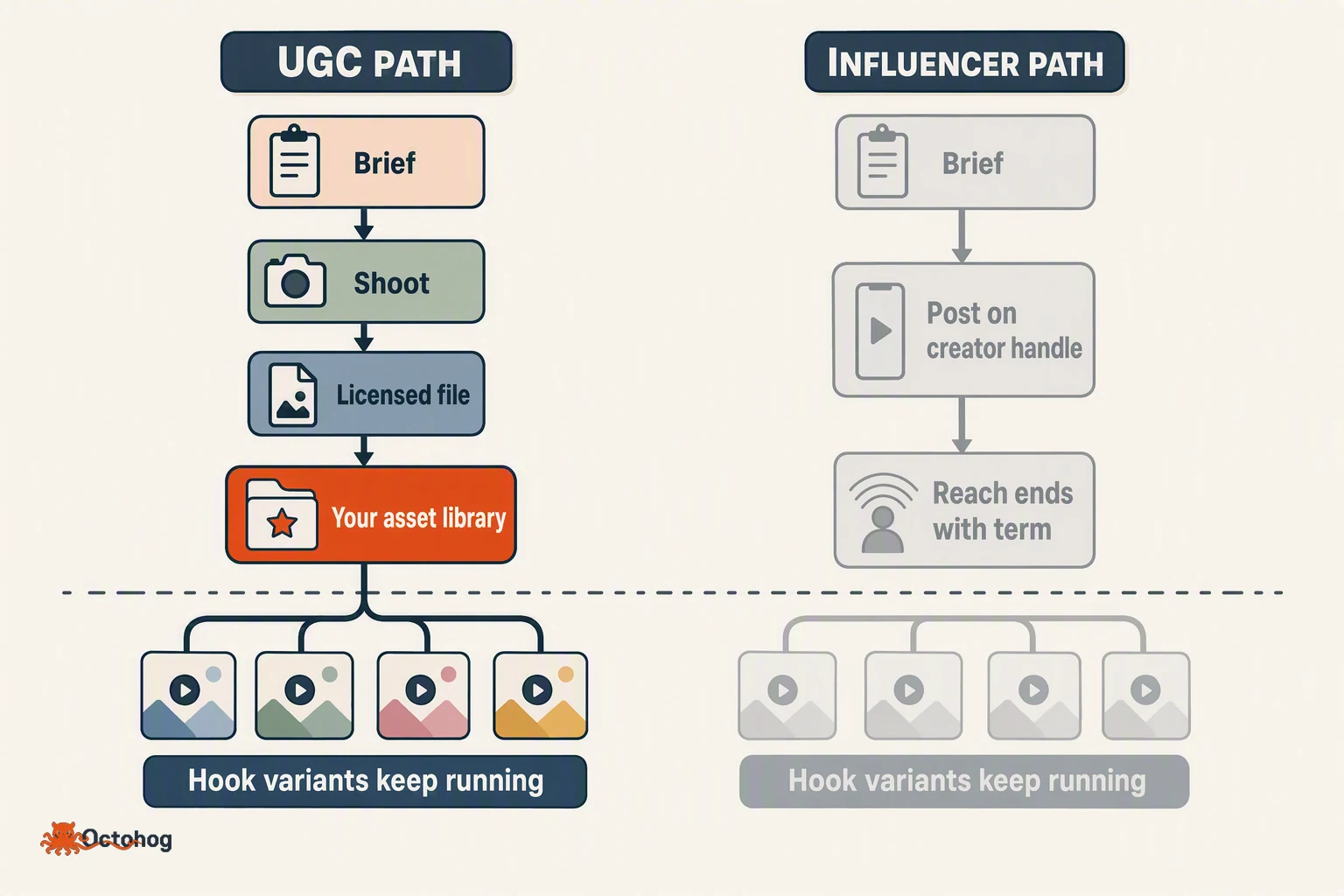
The table compares what one deliverable costs from a UGC creator versus an influencer, with the date each figure was checked and who owns the footage afterwards. Two source tiers sit in this table: the Insense row is a vendor's own list price, and the influencer rows are survey bands across many creators, so a single quote can sit outside them.
| Deliverable | Bought from | Price (date checked) | Who owns the footage |
|---|---|---|---|
| Three-creator package: edited videos, hook variations, USPs, B-roll, CTAs | Insense | From $450 (checked September 2026) [3] | Brand, per the licence term |
| Single video, organic-only licence | UGC creator | not published | Brand, term-limited |
| Photo set or raw footage add-on | UGC creator | not published | Brand, if the contract says so |
| Sponsored Instagram post, nano tier (1,000 to 10,000 followers) | Influencer | $20 to $200 (March 2026) [2] | Creator |
| Sponsored Instagram post, mega tier (1,000,000+ followers) | Influencer | $15,000 to $50,000 or more (March 2026) [2] | Creator |
| Whitelisting add-on on a sponsored post | Influencer | not published | Creator, brand licences ad rights |
Read the Instagram rows against each other before reading either alone. The nano band tops out at $200 and the mega band starts at $15,000 [2], so the same deliverable — one sponsored post on one platform — spans a 75x range with nothing published in between. That gap is the whole reason follower count cannot be treated as a price input you multiply. It is a category change, not a scale.
Influencers charging for UGC price off their post rate, not off a production rate, which is why the same 30-second video costs more when the person shooting it has an audience. You are paying a premium for a following you then decline to use. If the asset never runs on their handle, the follower count bought you nothing, and that is the single most common way a creator budget leaks.
Yes, UGC pays, and the package price shows the shape of it. Insense's three-creator bundle starts at $450 for edited video with hook variants and B-roll [3], which is $150 per creator per package ($450 / 3 = $150). Hold that against the nano Instagram floor of $20 to $200 per post [2] and the two prices turn out to be measuring different goods: the $150 buys a licensed file with hook variants and revision rounds, the $200 buys one placement that expires. Neither is the cheaper version of the other. A creator's ceiling comes from volume and rights, not reach.
Price the two against cost per acquisition, never cost per video. A $200 UGC asset that survives three weeks in a paid ad account beats a $15,000 sponsored post that ran once, and content pricing models that quote per deliverable make that comparison easy to run. Take last quarter's ad account, sort creatives by spend, and check how many were files you own.
Usage rights: what the license adds to the invoice
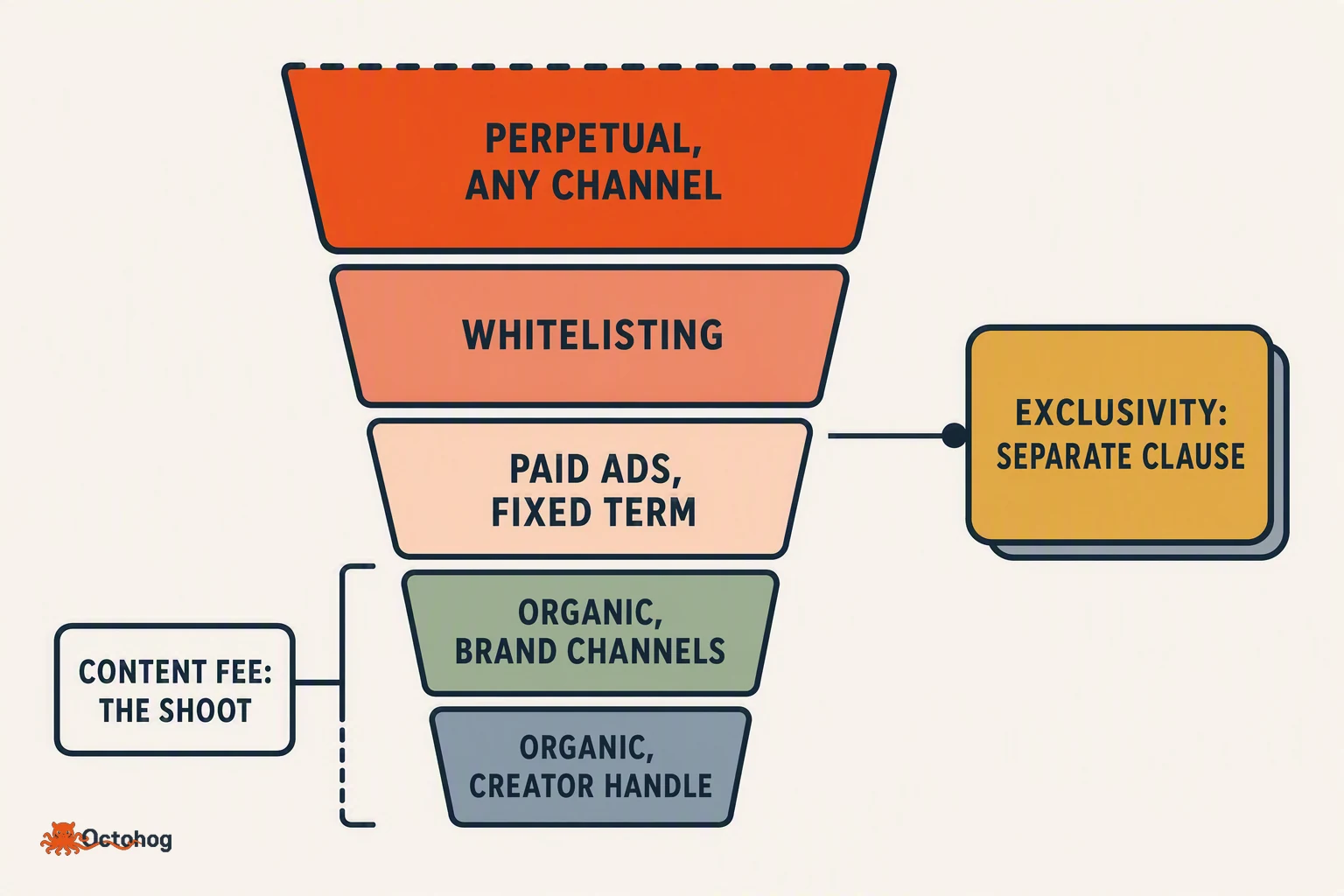
Price the license term before you price the video. The content fee buys the footage; the license decides where it runs, for how long, and on whose handle. 51% of influencers charge a fee to whitelist, boost, or amplify content on top of their usual rate [7]. That clause is what separates a quote from a final invoice.
Each row below is a license term, what it permits, and what the market adds to the content fee for it. The percentages come from a creator survey [7]. The 30-day terms come from one agency's standard deal reported by a trade publication [8], so they describe a common shape rather than a surveyed distribution.
| License term | What it permits | Add-on over the content fee |
|---|---|---|
| Organic-only, creator's handle | One post on the creator's own account | None; this is the base deal |
| Organic, brand channels | Reposting to your feed, stories, and site | Priced apart from the content fee [8] |
| Paid ads, 30-day term [8] | Running the asset as paid social | 0-100% of the base flat fee [7] |
| Whitelisting | Ads served from the creator's own handle | A separate fee for 51% of creators [7] |
| Exclusivity, 30 days | Creator stays off competing campaigns [8] | Its own line, negotiated separately |
| Perpetual, all channels | No end date, any placement | not published |
The 0 to 100% band on the paid-ads row is the one to read closely [7]. Its floor is zero, which means a real share of creators fold paid usage into the base fee and charge nothing extra — so a quote that itemises a usage fee is not automatically the honest one, and a quote that does not is not automatically hiding it. The band's width is also why a rights extension cannot be estimated from someone else's invoice. At the top of the range you are paying for the footage twice.
One talent agency's standard structure bundles 30 days of paid ad usage with two months of organic usage, both priced away from the content itself [8]. Copy that shape. It forces the channel list and the clock into the same conversation as the rate.
Cost a rights extension instead of guessing at it: take the base content fee, set aside up to 100% of it for the paid window [7], then treat every additional surface as its own term. Content repurposing beyond social is where quotes break. Amazon listings, retail screens, and paid search each carry distribution rights a social license never covered, and none of them have a published add-on rate — the "not published" on the perpetual row is the honest answer for those too.
Ask for the renewal price during the first negotiation, in writing. A term you extend after it lapses is a new deal at the creator's leverage, not yours.
Related reading
The scope-creep checklist to run before you sign
Vague quotes are not cheap quotes. They are quotes with the expensive parts deferred, and every clause below is a line item you will pay for later at a worse price. None of them has a published price — they are contract norms, not rates — which is exactly why they get deferred. Run the list before you countersign, not after the first delivery disappoints.
- Revision cap. Name the number of revision rounds and what counts as one. "Minor tweaks" is unlimited work.
- Reshoot trigger. Define what forces a reshoot: wrong product, wrong lighting, off-brief hook. Price it now.
- Raw-file delivery. State whether you receive raw footage or only the cut. Raw files are a separate deliverable everywhere.
- Hook variants. Count them in the brief. Three hooks over one video is three deliverables, not one edit.
- Term start date. Fix whether the license clock starts at delivery, at approval, or at first spend.
- Kill fee. Set what the creator keeps if you cancel post-shoot. Half the fee is the common landing spot.
- Renewal notice. Require written notice before the term lapses, with the extension price already agreed.
The clause most brands skip is the term start date, and it is the one that costs the most. A license dated at delivery burns weeks while your creative team argues about which cut runs, so you pay again for a window you never used. On a 30-day paid window [8], a fortnight of internal debate is half the term gone before the first impression — and the extension you then buy is priced at the creator's leverage.
Creative direction is the opposite problem: overspecified. Brands that send shot lists get an ad that reads like an ad, then blame quality control when it underperforms against the creator's own looser cut. Give the hook, the claim you cannot make, and the product handling rules. Leave the rest.
If a marketing agency or a digital marketing services vendor sits between you and the creator, ask which of these clauses their master agreement already covers. Most cover revisions and nothing else.
Sourcing, vetting, and partnership length
Vetting is four tests, and a creator who fails any of them is a bad fit you found before payment rather than after. Portfolio browsing is not vetting. Run these against every shortlist, whether it came from a ugc platform, a discovery search, or an inbound pitch.
- Portfolio-to-brief match. Ask for a past video in your category and format, not a highlight reel across ten categories.
- **Fake follower rate.** Check follower growth spikes and comment-to-like ratios before you weigh audience size at all.
- Posting gaps. Gaps longer than two weeks predict a missed deadline better than any reference does.
- Comment sentiment. Read the replies, not the count. Sarcasm and bot filler both inflate engagement.
Those four are industry practice rather than published methodology, and they are stated that way deliberately: no dataset ranks them, so treat them as screening heuristics and not as scores. Fake followers matter for an influencer partnership and matter far less for a UGC creator, because you are buying footage for your own ad account, not their audience. Vet a UGC creator on delivery reliability and on-camera fluency instead. That is the whole change in criteria.
On length: standard creator deals run about a month of paid usage alongside a 30-day exclusivity window that keeps the creator off competing brands during the campaign [8]. That figure is one agency's reported structure, not a surveyed median, so read it as the shape a negotiation starts from. Exclusivity beyond a single quarter should cost real money, because you are asking a creator to turn down their category.
Retainers beat one-offs once you re-brief the same person monthly. Three creators on a rolling monthly agreement produce a usable back catalogue and a brief they no longer need explained.
Where a creator posts on their own account, pair the deal with affiliate marketing terms and a unique discount code. Code tracking gives you attribution the platform will not.
Turnaround: how long each one takes to deliver
Turnaround is decided by the contract stage, not the shoot. A creator edits a video in an evening or two. Agreeing the usage clause takes rounds of email, and that is where launch dates die.
The table sets brief-to-asset and brief-to-live time against the stage that consumes most of it. Only the first row rests on a published figure — the five-to-seven-day creator turnaround [1]. The rest are stated as ranges because no source publishes contract-cycle times.
| Path | Brief to first cut | Brief to live | Stage that eats the days |
|---|---|---|---|
| UGC creator, hired direct | About a week after product arrives | Same day as your approval | Shipping the product and settling usage rights |
| Marketplace order | Days, not weeks | Days, not weeks | Reshoot rounds when the brief was thin |
| Negotiated influencer post | Two to three weeks | The creator's own posting calendar | Contract redlines and exclusivity |
Read the marketplace clock carefully. What gets sold as "delivery time" starts when the creator receives your product, not when you pay, so add shipping to every estimate. That is what the five-to-seven-day standard actually measures [1] — the edit, not the logistics around it.
For a product launch, back-date from the influencer path and let UGC fill in behind it. Campaign speed scales the same way volume does: brief ten creators at once with one shared spec, and the slow one stops being the schedule.
Marketing funnel: which format earns its cost at each stage
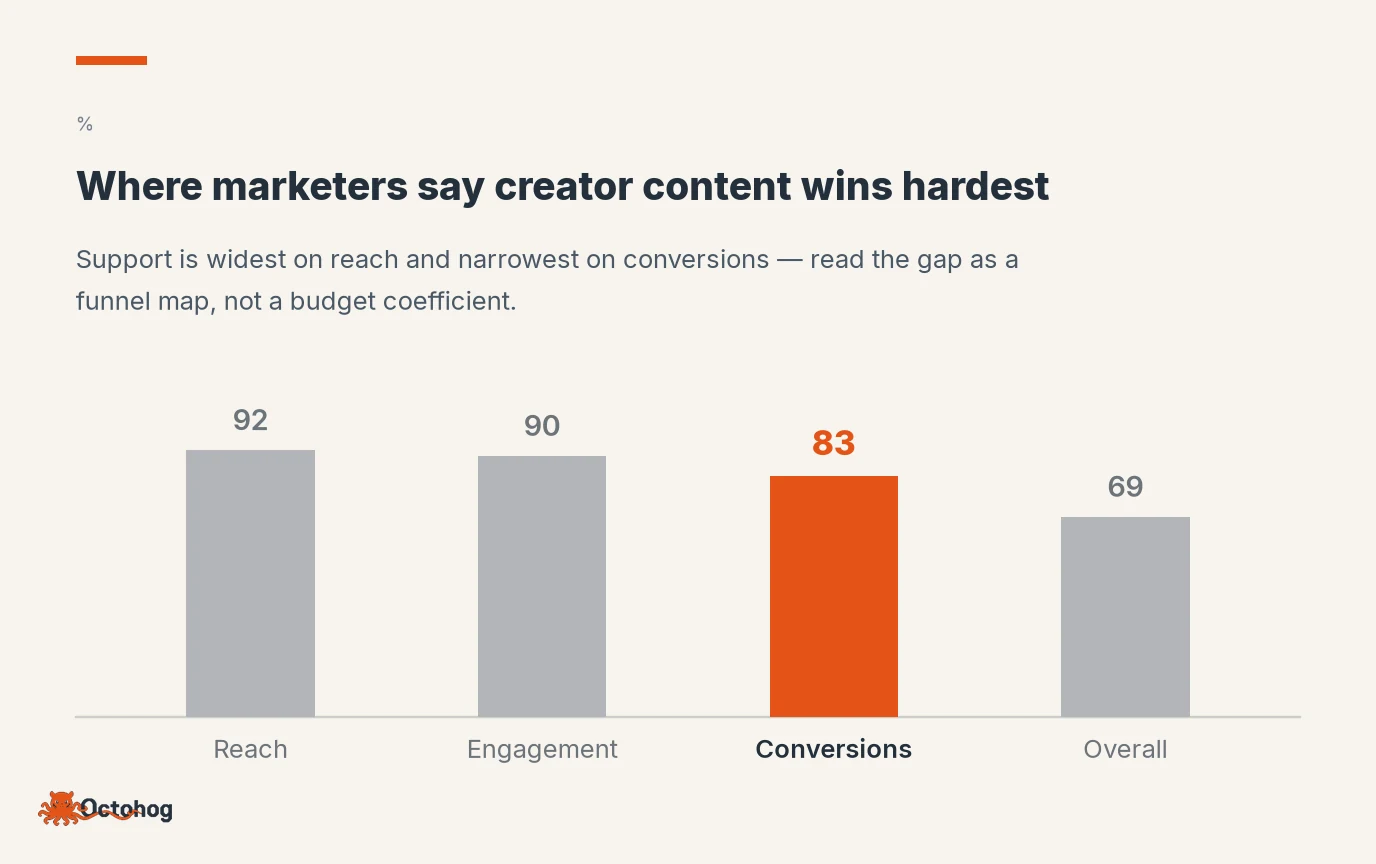
Influencer spend and UGC spend answer to different numbers, and mixing the two benchmarks is how a good campaign gets killed. Hold influencer awareness buys to CPM, reach, and attention duration: influencer ads sustain 1.4 times longer viewer attention than traditional ad content, which is the upper-funnel case in one figure [9]. Hold UGC ad creative to CTR, cost per acquisition, and how many days pass before frequency kills the hook. Different jobs, different scoreboards.
Marketer survey data splits the same way, and the split is the useful part rather than the headline. 69% of marketers say influencer-generated content outperforms brand-directed content overall [4], but that aggregate hides a spread: the margin is widest on reach at 92% and narrowest on conversions at 83%, with engagement between them at 90% [4]. Read that gap as the funnel map it is — the further down you go, the less the creator's audience does for you and the more the creative itself has to carry. Note also what these numbers are: marketers reporting their own perception of performance, not measured lift. A nine-point spread between reach and conversions is a directional signal about where creator distribution stops helping, not a coefficient to plan a budget against.
At the top, measure the tier, not the total. Nano-influencers on TikTok average a 10.3% engagement rate [9], and that is the benchmark a paid partnership with a larger account has to beat before the reach premium is worth anything. Micro influencer performance holds up on rate but delivers a fraction of the impressions, so ten nano placements and one macro placement are not interchangeable line items even at matched spend. Earned media value belongs here too, and only here. It is a plausible proxy for awareness and a useless one for a conversion campaign, because nobody has ever paid a supplier in EMV.
At the bottom, the metric is creative fatigue. UGC ad creative is bought in volume because CPA drifts up as frequency climbs, and the fix is a new hook rather than a bigger bid. Budget for the replacement cycle when you sign the creator, not when the numbers slip. Three hooks per creator, refreshed on a schedule you set in advance, beats one video defended for six weeks.
Octohog
Reading about UGC is the slow way to get UGC.
Write the brief once. Octohog finds the creators who fit it, shows their real brand work, and runs the outreach that books them.
Start with a brief7-day free trial
Which one should you pick
Match the choice to the job, not to the price tag:
- Under $2,000 and you need ads that convert — UGC creators. Four to six videos beats one sponsored post, because you need variants to test.
- Launching a new product with no audience — influencers first. Insense, a platform in this market, positions influencers as the awareness-stage opener and UGC as the follow-on volume that keeps the message running afterwards [5]; that is a vendor's own framing, and it matches the funnel split in the survey data above [4].
- Running paid social every week — UGC creators on retainer. Volume is the requirement, and one-off bookings price it badly.
- Selling into a defined niche — a niched Instagram influencer. 22% of marketers rank that channel as their next-highest-ROI after Facebook [11].
- Fixed budget across both — route the majority to UGC ad creative and the rest to two or three niche influencer placements per quarter.
- Needing the footage for a year of ads — UGC creators, with a buyout in the contract. An influencer post you cannot re-cut is rented reach.
The hybrid path is the default for anyone already spending on paid social, and the reason is unglamorous: UGC gives you assets you own, influencers give you an audience you do not. Splitting is not indecision when each line item has its own metric.
Count the switching cost before you commit. Leaving an influencer roster means the reach disappears the day the contract ends, and nothing you paid for stays on your ad account. Leaving a UGC roster costs you the briefing relationship and the creators who already know your product, which takes about two months to rebuild with new people. The asset library stays.
Frequently asked questions
Is UGC still a thing in 2026?
UGC is still a working paid channel in 2026, and the reason is arithmetic rather than fashion: it is the cheapest way to get enough creative variants to test a hook properly. Creator-led buying behaviour holds up too, with 58% of US consumers over 18 saying they have purchased a product because of an influencer endorsement [9], per BBB National Programs data reported in January 2026. That is self-reported purchase behaviour rather than tracked conversion, so read it as evidence the channel still moves people, not as an expected conversion rate. What has changed is the pricing, not the demand.
Can you actually make money doing UGC?
Creators make money on UGC, and the money arrives as self-employment income rather than a salary. A brand only issues a 1099-NEC once that single payer has paid $600 or more in the year, but every dollar of creator income is reportable whether or not a form shows up [10]. Set aside tax from the first invoice. Two or three brands on retainer beats chasing one-off bookings.
How much do influencers charge for UGC?
Influencers charge more for UGC than dedicated UGC creators do, because they are pricing their audience into a deliverable that does not use it. No published survey covers this specific rate, so expect a premium over the standard per-video rate rather than a quotable band, and expect the usage-rights term to drive more of the quote than the follower count does — a paid-usage add-on alone can reach 100% of the base content fee [7]. Ask for the video-only price with no post attached.
How many followers do you need to be a UGC creator?
UGC creators need no follower minimum, because the brand runs the video on its own accounts. What buyers screen for is lighting, clear audio, on-camera delivery, and turnaround. A portfolio of three to five sample videos does more for booking rate than a follower count does. That is the whole entry requirement.
References
- What is a UGC creator? A brand's guide | Hubfluence — hubfluence.io
- Influencer rates: How to maximize your budget in 2026 — hootsuite.com
- Pricing guidelines for UGC campaigns — insense.pro
- 32 influencer marketing statistics to guide your brand's strategy in 2026 — sproutsocial.com
- UGC Creators vs Influencers: A Guide to Choosing the Right Content Partner — insense.pro
- Disclosures 101 for Social Media Influencers — ftc.gov
- How Do Influencers Charge for Whitelisting and Usage Rights? — lumanu.com
- Marketers say usage rights are driving up the price to work with creators — digiday.com
- FAQ on influencer marketing: Why brands are betting on it in 2026 — emarketer.com
- Tax Tips for Content Creators — intuit.com
- 2026 Marketing Statistics, Trends, & Data — hubspot.com