UGC Creator Brief Template: Name the Rate First

· 15 min read

Last updated: 2026-08-31
A UGC creator brief should name the rate, the scope, the usage window and the revision cap before it names a single hook. Most briefs do the opposite, and that ordering is what produces reshoots: content a creator posts to their own feed typically costs about 20% more than the same video delivered only for the brand's use [2], so a brief that never says where the video runs has not asked for a quote. One page is the working ceiling, and extra detail past it buries the message rather than clarifying it [5]. Commercial terms first, creative second.
Below: what a brief is and where it stops being one, the four commercial fields that go on page one, a two-round revision cap with a written definition of "revision", the format and delivery block, a copy-paste template, the four fields that change by platform, and five clauses that cost money.
What is a UGC creator brief?
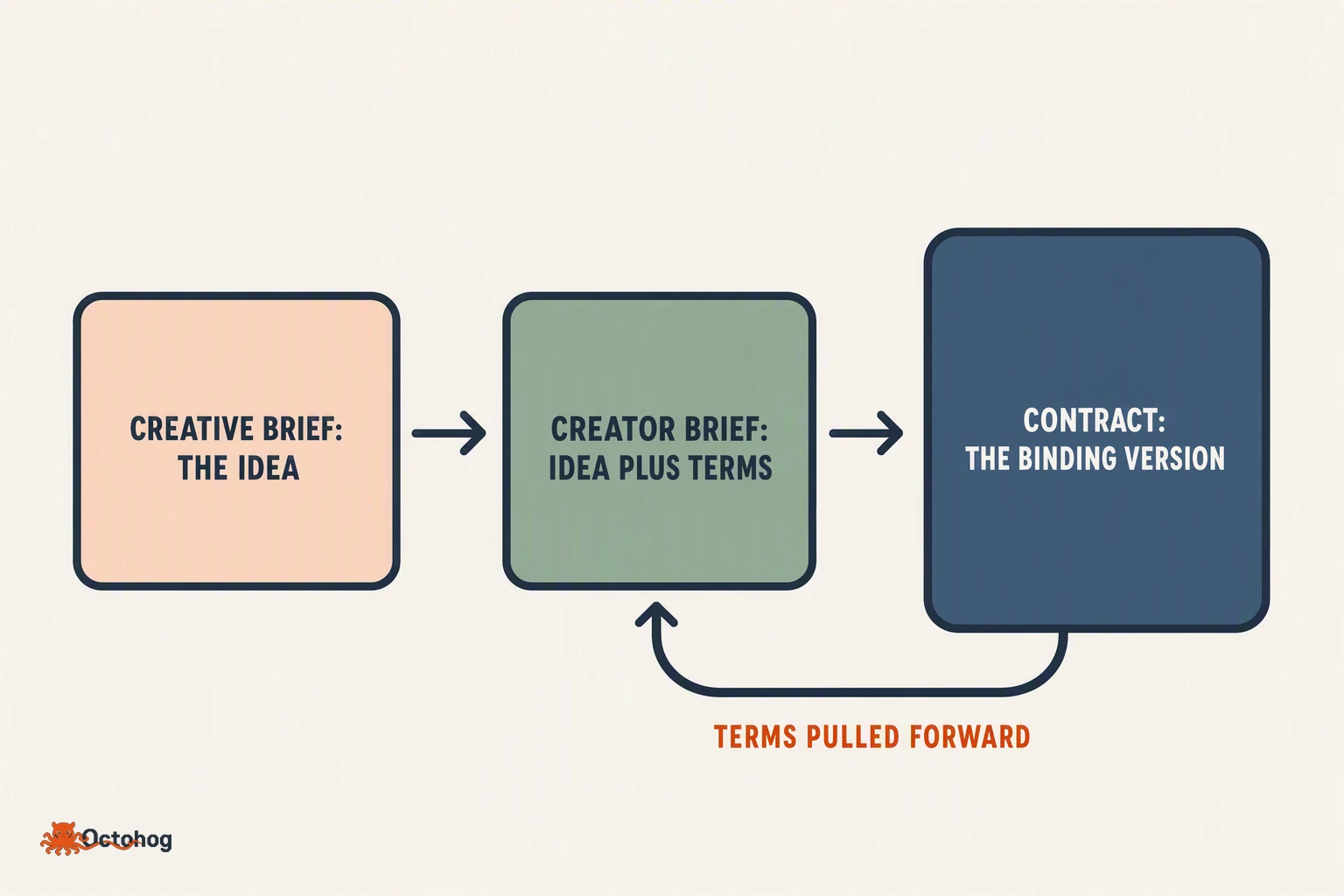
A UGC creator brief is the working document a brand sends a creator before filming: it names the product, the hook, the deliverables, the shot list, and the tone. A creative brief is its broader cousin, used for any campaign asset including agency-produced ads. Neither one is the contract.
That last distinction is where money goes missing. The contract, not the creative brief, is the document that carries payment terms, deliverable definitions, and bonus structure [1]. Most brief templates on the first page of Google honour that split and stop at creative direction, which leaves the creator guessing at the rate until an invoice lands.
An example of a creative brief: a two-page Notion doc for a skincare launch with objective, audience, three hook lines, a five-shot list, and brand-safety notes. Useful. Silent on price.
A UGC creator brief that works pulls four fields back from the contract and puts them on page one: base rate, deliverable count, usage term, revision cap. The contract still binds them. The brief just stops the negotiation from happening after the footage exists.
The three documents, in order
- Creative brief — the idea, the audience, the hooks. Written by the brand.
- UGC creator brief — the idea plus the commercial terms, sent to one named creator.
- Creator contract — the binding version, signed, carrying payment and rights.
Octohog
You know what to pay. Octohog finds who to pay.
Rank creators against your brief, check the brand work behind every name, and send the invites from your own inbox. Brief to booked in one flow.
Start a campaignGmail-native outreach
Vague pricing is the failure mode, not vague creative
Reshoots rarely start with a bad hook. They start with a creator who priced a video for one thing and a brand that briefed them for another. Usage rights are the specific fault line: content a creator posts to their own feed typically costs about 20% more than the same content delivered only for the brand's use [2]. A brief that omits where the video will run is a brief that has not asked for a quote.
Follower count moves the number too, and it moves it further than most brands budget for. Creators above 50,000 followers charge roughly 3x more per video than those in the 5,000-10,000 band — €355 against €110 [2]. So the honest answer to what a UGC creator makes is a range, not a rate: a beginner working from home clears low three figures per video, and a creator with a track record and an audience clears three to four times that. Per video. Not per month.
The operational cost shows up further downstream. Rights management, whitelisting and compliance workflow are the bottleneck that bites as UGC budgets scale — a finding drawn from a survey of over 600 marketers [3]. Rights management is a bottleneck because it is retroactive. Somebody has to go back through delivered footage and find out what was licensed.
Now read the ranking brief templates on this query — influee.co, insense.pro, joinbrands.com. Every one covers objective, audience, hooks, do-not-say lists and shot direction. None carries a field for the rate, the usage term, or the revision cap. The creative direction in those templates is genuinely good. The commercial half is simply absent, which is why so many campaigns run two documents out of sync and settle the difference by email after delivery.
Fix the sequence, not the template. Price the license term before you price the video.
Write the rate, scope and usage line before anything else
Fill four fields before you write a single hook line. Each one is a number or a date, not a paragraph — if a field needs a sentence to explain it, it is not settled yet.
- Base rate. Entry-level UGC creators typically charge $50-$100 per video; established creators with proven track records command $500 or more before licensing is added [4]. Roughly 80% of UGC creator cost responses come in under $500, with the rest mostly between $500 and $2,000 [3]. That is the whole market in one line.
- Deliverable count. State the number of finished videos, the number of hook variants, and the aspect ratios. Three videos with three hooks each is nine assets, not three.
- Usage term. Name the channels and the months: organic-only on the brand handle, 6 months, or paid social including Meta and TikTok, 12 months. Adding six months of global usage or paid-campaign handle rights pushes a $200 base video well past its starting price [4].
- Exclusivity. Name the category and the window, or write "none". Ninety days of no competing skincare brands is a real cost to a creator and should carry its own line, separate from the base rate.
So a $200 base plus a paid-usage upgrade lands the same video above its starting price [4] while still sitting under $500, which is where four-fifths of the market sits [3]. The base rate is the smallest number in the block. Brands anchor on it anyway.
Who owns the footage
IP ownership and usage rights are separate questions, and briefs collapse them constantly. Usage rights are a licence with an end date; ownership is a transfer. A creator who assigns full IP loses the right to reuse that footage in their own portfolio forever, and prices accordingly. Buy the licence. Buy ownership only when a founder appears on camera or the footage names a competitor.
Performance bonuses belong in this block too, tied to a metric the creator can see: a flat $100 on any video that clears your CPA target. Bonuses paid on numbers only the brand can measure get treated as fiction, and they should be.
Cap revisions in writing, then say what a revision is
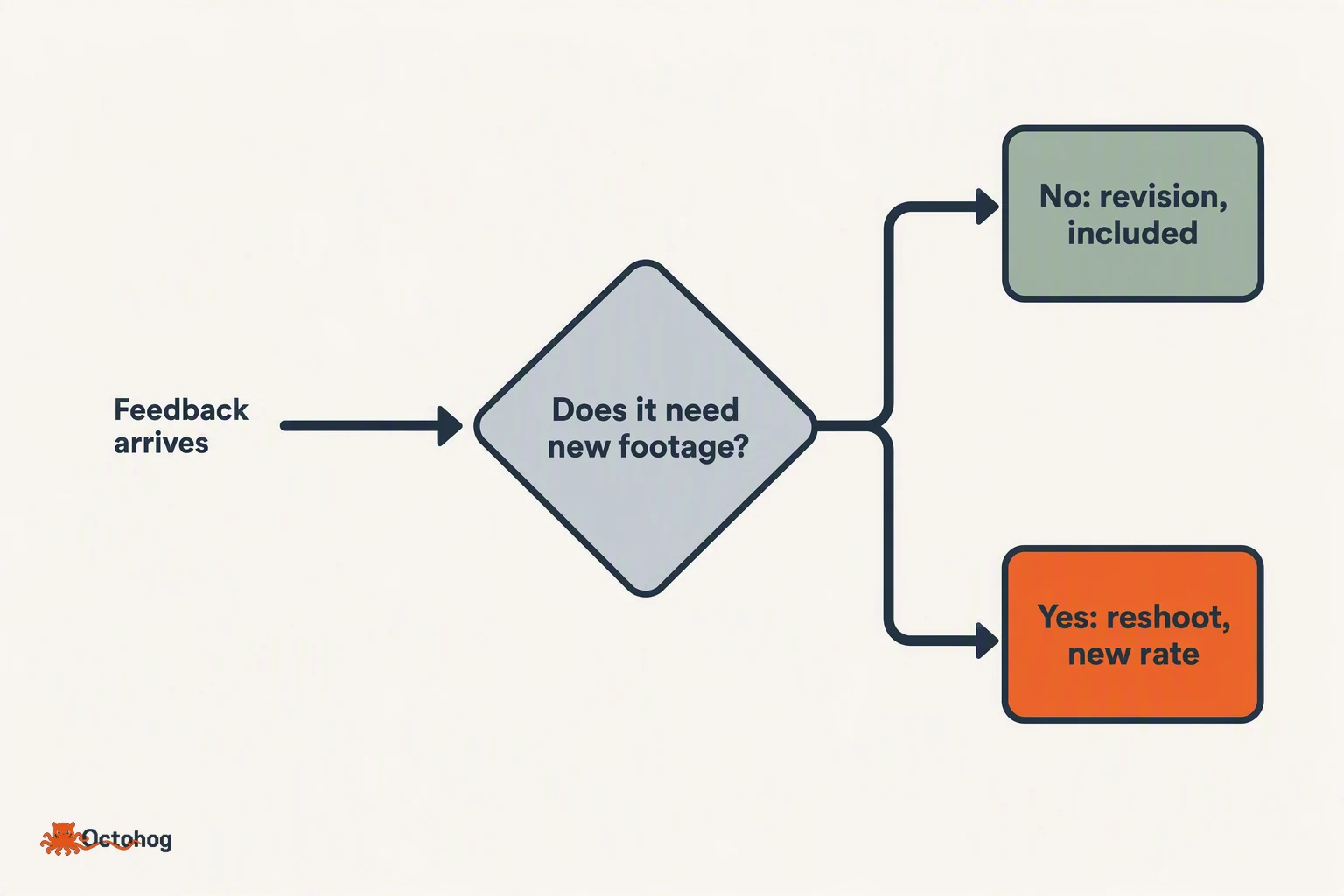
Two rounds. Write the number in the brief, and write the definition next to it, because a revision cap without a definition just moves the argument one step later. Rush fees and multiple revisions are the layers most likely to push a video's cost above its base rate when timelines are tight [4]. Uncapped feedback is the version of that cost the brand never sees on an invoice — the creator absorbs it once and quotes higher next time.
A revision is a change to something already in the brief: the hook line was delivered wrong, the product label faces away from camera, the caption text overlaps the safe zone. A reshoot is a change to the brief itself. New location, new outfit, a hook nobody wrote down before filming — that is a new shoot at a new rate, and saying so in advance is the entire clause.
The wording that holds up on both sides:
Two rounds of revisions included, consolidated into one feedback message per round, returned within 3 business days. Changes requiring new footage are a reshoot, billed at 50% of the base rate.
The consolidation half matters more than the cap. Four stakeholders sending notes on Slack across a week is one round by the brand's count and four by the creator's, and both are arguing honestly. One document, one deadline, one voice.
Name the approver in the brief by name and title. Not "the marketing team". If a person who never saw the brief can reject the video, the revision cap does nothing, and the creator learns to price your account as high-friction.
Related reading
Past one page, extra creative direction stops reducing revisions
Past that, the brief starts costing you footage instead of saving revisions. One page is the ceiling worth holding to, because packing in more detail is what makes a brief's main message get lost [5]. The failure is not length on its own. It is that a creator reading page three has stopped reading for intent and started reading for compliance, and compliance footage looks like compliance footage.
Three creative fields carry the load. A one-to-two-page TikTok Shop brief structure narrows creative direction to exactly those three: three to five hook options, one core key message, and a two-column do's-and-don'ts list [6]. Everything else on the page is commercial, not creative.
Cut a bloated brief to these:
- Hook options: three to five opening lines, written out, with the creator free to pick or pitch a sixth.
- Key message: one sentence the video must land. Not three.
- Do's and don'ts: two columns, claims and compliance on the don'ts side, brand voice guidance on the do's side.
- Reference links: two examples maximum, labelled with what you want copied from each.
- Everything else: delete, or move it to the commercial block on page one.
A design brief in the classic agency sense has seven parts: company background, objective, audience, scope, budget, timeline, and deliverables. A UGC brief keeps the commercial five and compresses the creative two into the fields above. That is the whole difference. Design briefs are written to be approved by a committee; creator briefs are written to be read once on a phone, in a kitchen, before filming.
Set creative freedom boundaries as prohibitions, not prescriptions. "Don't say clinically proven" is enforceable and takes four seconds to read. "Capture our warm, approachable, confident brand personality" is neither, and it is the line that produces the stiff take you will pay to reshoot.
Set the specs and the delivery date in the same block
Specs and deadline belong in the same block because a creator who has to scroll for the aspect ratio will also guess at the due date. Put them side by side, as fields with values in them.
- Aspect ratio: 9:16 vertical as the master. TikTok in-feed ads accept 9:16, 16:9, or 1:1 [7], so name which crops you also want exported rather than assuming a reframe is free.
- Resolution: 540x960px is TikTok's stated minimum for in-feed video ads [7]. Brief 1080x1920 anyway; you cannot upscale later.
- Duration: TikTok permits video ads up to 10 minutes [7], which is irrelevant to you. Ask for the length you will actually run, plus one shorter cutdown.
- File format and size: .mp4 or .mov, under 500MB, per TikTok's ad specs [7].
- Raw footage: state yes or no in the field. Unedited clips are a separate deliverable and usually a separate line item.
- Delivery: a named Drive or Dropbox folder, plus a file-naming pattern like brand_creator_hook1_9x16.
- Deadline: a calendar date and a timezone. Never "ASAP".
Turnaround is where 2026 briefs still lie to themselves. Editing time is only part of the clock: the product has to reach the creator before filming starts, and shipping adds whatever your courier adds on top of the days the shoot and edit take. A batch of videos runs longer than a single one, and rush windows are a pricing conversation rather than a scheduling one — rush fees are among the layers most likely to push a video above its base rate when timelines are tight [4].
Write the product-arrival date in the deadline field too. Half of late deliveries are late because the sample shipped at the end of the turnaround window, and the creator gets blamed for a logistics decision they never saw.
The copy-paste UGC creator brief template
Paste this into a doc or a platform message and fill every field before you send it. Fields in this order, commercial first:
- Campaign and product — brand, product name, one-line positioning, link to the PDP.
- Rate — flat fee per video, in figures, with the currency.
- Scope — number of videos, number of hooks per video, cutdowns included.
- Usage rights — channels, territory, and term. Organic-only and paid-ads-included are different prices; write which one this fee buys.
- Revisions — the cap as a number, plus a one-line definition of what counts as a revision.
- Payment terms — trigger, method, and days to payment.
- Hook options — three to five written openers.
- Key message — one sentence.
- Do's and don'ts — two columns.
- Specs and delivery — aspect ratio, resolution, file format, folder, file naming.
- Deadline — date, timezone, and the date the product ships.
That numbered list is the example of a creative brief most people are looking for when they search for one: a filled form, not a strategy document. A filled version reads like "Rate: $250 flat. Scope: 1 video, 3 hooks, 1 cutdown. Usage: organic TikTok and Instagram, 6 months, no paid. Revisions: 2." Four lines, no ambiguity, no follow-up thread.
Keep the whole thing to one or two pages. The framing worth stealing is that a brief that reads like a contract gets ignored, while one that reads like a cheat sheet gets used [6].
Reusability is the point of fields one through six. Once your rate, usage-rights and revision language is settled, those blocks change only in their values from campaign to campaign, and the per-brief work drops to the four creative fields. Duplicate the doc, swap the product, change the numbers.
Send the next brief with fields two through six filled before you write a single hook. If a creator declines at that stage, you lost ten minutes instead of a shoot.
Which brief fields change by campaign type and platform
Four fields carry the campaign difference: objective, format spec, hook count, and usage window. Everything else in the template — rate, revision limit, delivery date — stays constant whether the video is for a TikTok organic post or a Meta retargeting set. Swap those four, keep the rest.
Format specification is the field creators get wrong most, because it is the one the platform decides for them. Standard in-feed ads accept vertical 9:16 at a minimum 540x960px, horizontal 16:9 at 960x540px, or square 1:1 at 640x640px, so the brief's format field has to name the placement, not just say "vertical" [8]. Duration splits the same way. Spark Ads, which put paid spend behind a creator's existing organic post, carry no restriction on video length, while standard non-Spark in-feed ads cap at 10 minutes and 500 MB [8].
This table maps the four swappable fields against the three campaign objectives most DTC brands run.
| Field | Awareness | Conversion | Retention |
|---|---|---|---|
| Objective line | Reach and saves | Cost per acquisition | Repeat purchase rate |
| Format spec | 9:16, under 30s | 9:16 plus 1:1 cutdown | 9:16, under 20s |
| Hooks requested | 3 variants | 5 variants | 1, plus voiceover |
| Usage window | 30 days organic | 90 days paid | 6 months paid |
Conversion campaigns are where the field count justifies itself. Five hooks against one body of footage gives the media buyer something to test in week one, and conversion rate optimization on UGC is mostly hook testing with the same footage underneath. Awareness briefs asking for five hooks are wasting the creator's shoot day.
For UGC for paid ads, add one line the organic brief never needs: the ad account the video will run from. Spark Ads need the creator's authorization code; a dark post does not. Ask for the code in the brief, not in a message three days after delivery.
Octohog
You know what to pay. Octohog finds who to pay.
Rank creators against your brief, check the brand work behind every name, and send the invites from your own inbox. Brief to booked in one flow.
Start a campaignGmail-native outreach
Where these briefs break: five clauses that cost money
Perpetual rights language is the clause that costs the most, and it usually arrives disguised as tidiness. "Brand may use the content in perpetuity across all channels" reads like boilerplate and prices like a buyout. Creators who sign it lose the ability to re-license the same footage later, and brands who write it pay a premium they rarely need — most UGC ads stop performing well before a perpetual term would ever matter. Name a term. Six months, twelve months, renewable.
Whitelisting buried in a footer is second. Running ads from a creator's own handle is a different product from running them from the brand's ad account: the creator's name, face and follower count are the identity on the ad, and that carries reputational risk they did not price. Whitelisting belongs in the commercial block on page one, with its own fee, not in a compliance appendix — it sits alongside rights management as one of the workflows that bottlenecks as budgets scale [3]. Meta Branded Content tagging requirements sit in the same block, because whoever runs the ad has to set the tag.
Exclusivity is the clause most briefs skip entirely. Without a window, nothing stops the creator from shooting a competitor the following week, and nothing entitles the brand to complain. Write the category and the number of days. A skincare brand asking for 90 days of category exclusivity should expect to pay for it.
No kill fee is the omission creators feel and brands do not. If a shoot is cancelled after the product ships, someone absorbed the prep time. Half the rate is the standard ask.
Fix order, if your budget is tight: term length first, then kill fee, then exclusivity. IP ownership language and measurement fields matter, but a brief that names its performance metrics and still says "in perpetuity" is a brief that lost money on line one.
Frequently asked questions
What exactly is an UGC creator?
A UGC creator is a paid content producer who shoots brand-owned video in the style of an ordinary customer post, then hands the footage to the brand to run. Unlike an influencer, a UGC creator sells the asset, not the audience — nothing has to post to their own account, and follower count does not set the rate.
What is an example of a creative brief?
The template in this guide is one: a commercial block naming rate, usage term, revision limit and kill fee, followed by objective, format specification, hook count and delivery date. A TikTok conversion brief built on it fits on one page and names 9:16 as the format, five hooks, and a 90-day paid usage window.
What are the 7 parts of a design brief?
A design brief usually runs: background, objective, audience, scope and deliverables, budget, timeline, and approval process. A UGC creator brief keeps all seven and adds three the design version has no reason to carry — usage rights, revision limit, and exclusivity window. Those three are where the money moves.
How much money does an UGC creator make?
UGC creator earnings depend on the license, not the follower count. An organic-only video with a short usage term sits at the bottom of the market; the same footage with paid rights, whitelisting and category exclusivity attached can price several times higher. Creators who itemize those add-ons on the brief earn more per shoot day than creators quoting one flat number.
References
- Creator contracts and creative briefs, explained — hubfluence.io
- UGC Video Pricing in 2026: How Much Should You Pay Content Creators? — influence4you.com
- Influencer Marketing Benchmark Report 2026 — influencermarketinghub.com
- UGC Rates in 2025: What Brands Actually Pay (Why It Varies) — billo.app
- Common UGC Brief Mistakes Brands Still Make in 2025 — billo.app
- How to write a TikTok Shop creative brief — hubfluence.io
- TikTok Auction In-Feed Ads | TikTok Ads Manager — tiktok.com
- TikTok Auction In-Feed Ads | TikTok Ads Manager — tiktok.com